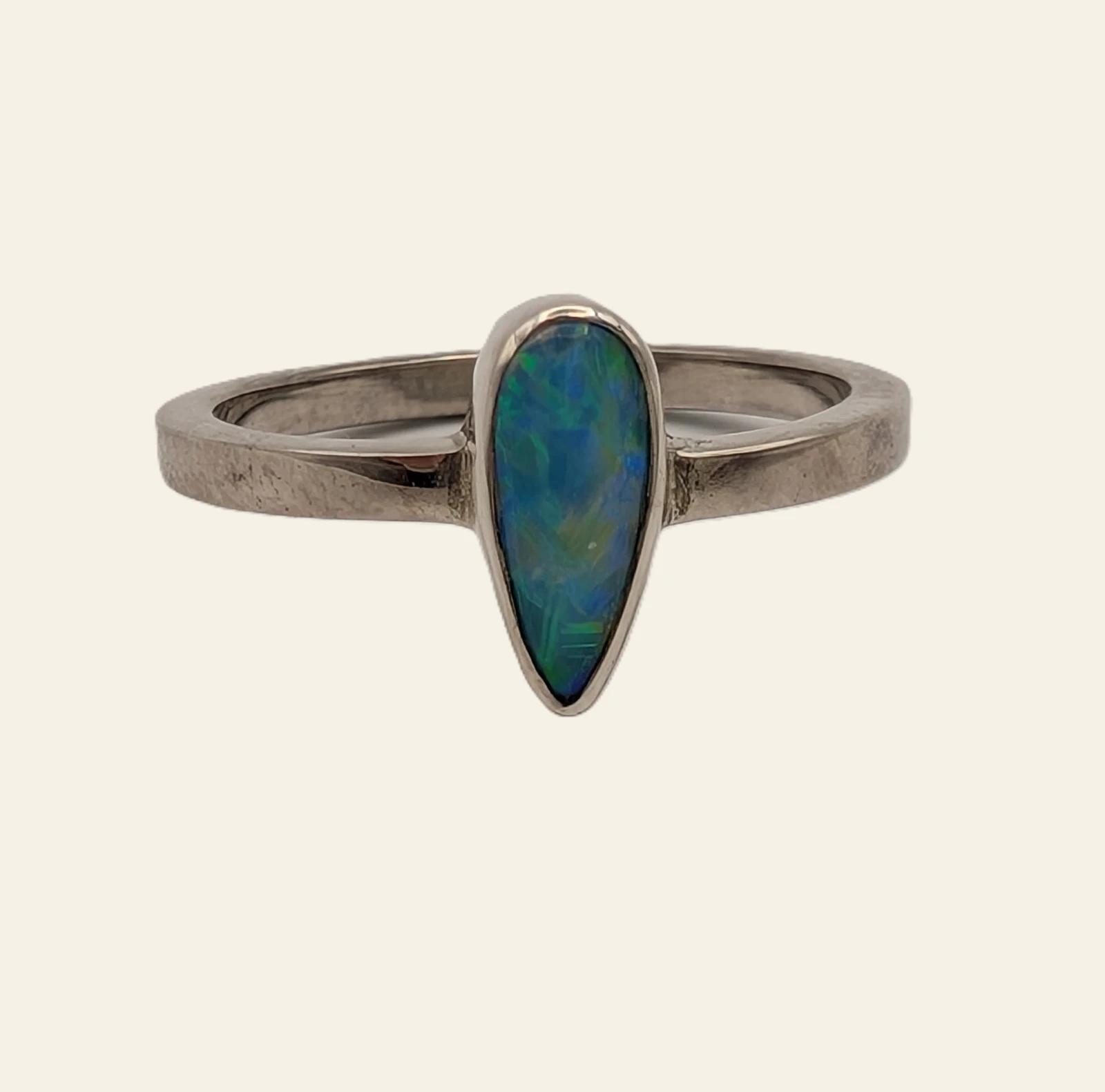
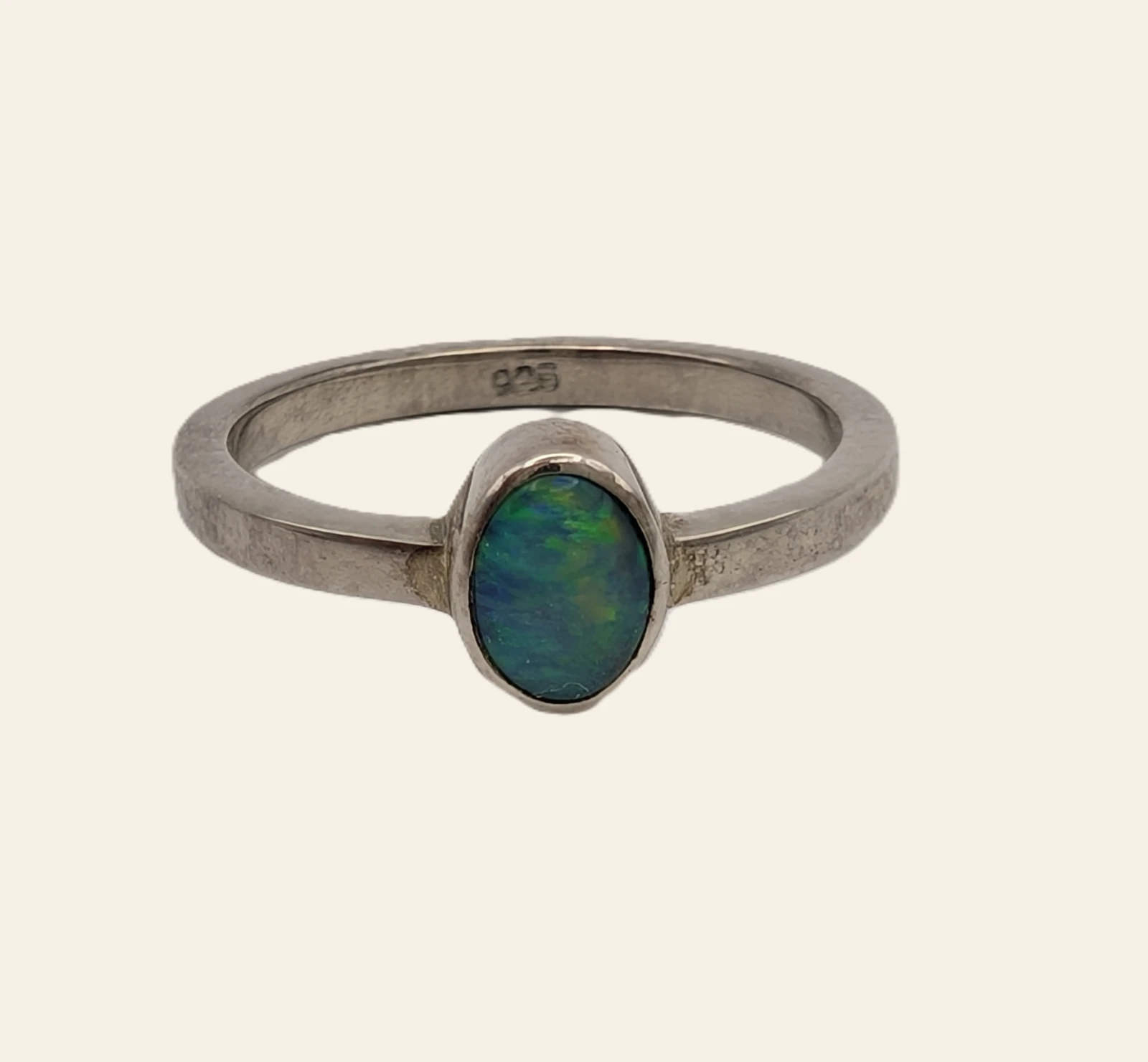
Confetti Light
$400
ring
Qld Boulder Opal
Genuine Australian opal rings and pendants — never doublets, triplets, lab-created or hydrophane.
Real opal is one solid natural stone, through and through. No glue line. No dome. Not grown in a factory in three weeks. Not a hydrophane that drinks your bathwater and goes transparent while it dries. It came out of the ground looking roughly like that, and a cutter took away everything that wasn't the colour.
Almost every seller online will tell you their opal is real, and most of them are not lying — they are using a word that has been stretched until it carries no weight. A lab-created opal is really an opal, chemically. A doublet contains real opal. Both are legitimate products, honestly sold, at honest prices. The problem is the word "solid" going quietly missing from the listing.
A doublet is a thin slice of genuine opal glued to a dark backing — ironstone or black glass — to fake black opal's contrast. It should cost tens to a couple of hundred dollars. A triplet adds a clear quartz or glass dome over an even thinner slice, and should cost tens of dollars.
Lab-created opal is grown, not mined, and can be identified by its too-regular columnar pattern. It should cost very little. Treated opal — smoked, sugar-dipped, dyed — is natural stone darkened to imitate a black opal body tone, and should be priced as treated material and labelled as such.
Hold those four numbers in your head and you can price-check anyone. Big, vivid, dark and cheap is not a bargain; it is one of the four. The long version, with what to look for on the stone itself, is in how to tell if an opal is real.
Construction: solid natural opal. Body tone on the N1–N9 scale. Mine of origin — Lightning Ridge, NSW or the Queensland boulder fields, named, not "Australia" as a shrug. Carat weight of the cut stone. Treatment: none. Signed by the person who cut it.
A certificate that says "certificate of authenticity" across the top and nothing specific underneath is a printed reassurance, not a document. If a seller's paper doesn't state construction and origin in words you could argue with, it isn't stating anything.
Is it solid? What is the body tone? Where was it mined? Those three answers take a real seller one sentence each. I can answer them for every stone on this page without looking anything up, because I bought the rough and cut it.
If the answers arrive slowly, or come back as marketing — "ethically sourced genuine Australian-style opal" — you have your answer already. Walk. There is more opal.
Australian opal is non-hydrophane. It formed in sedimentary rock over millions of years and it is stable in water and daily wear. That stability is the reason "Australian" is the word every opal seller in the world would like to borrow, and the reason origin belongs on the certificate rather than in the copy.
Ethiopian Welo opal is beautiful, often brighter for the money, and porous. Soak one and it can go temporarily transparent or craze as it dries. Sold honestly it is a good stone at a fair price — see Australian vs. Ethiopian opal. Sold as "Australian", it is a problem.
Keep reading